
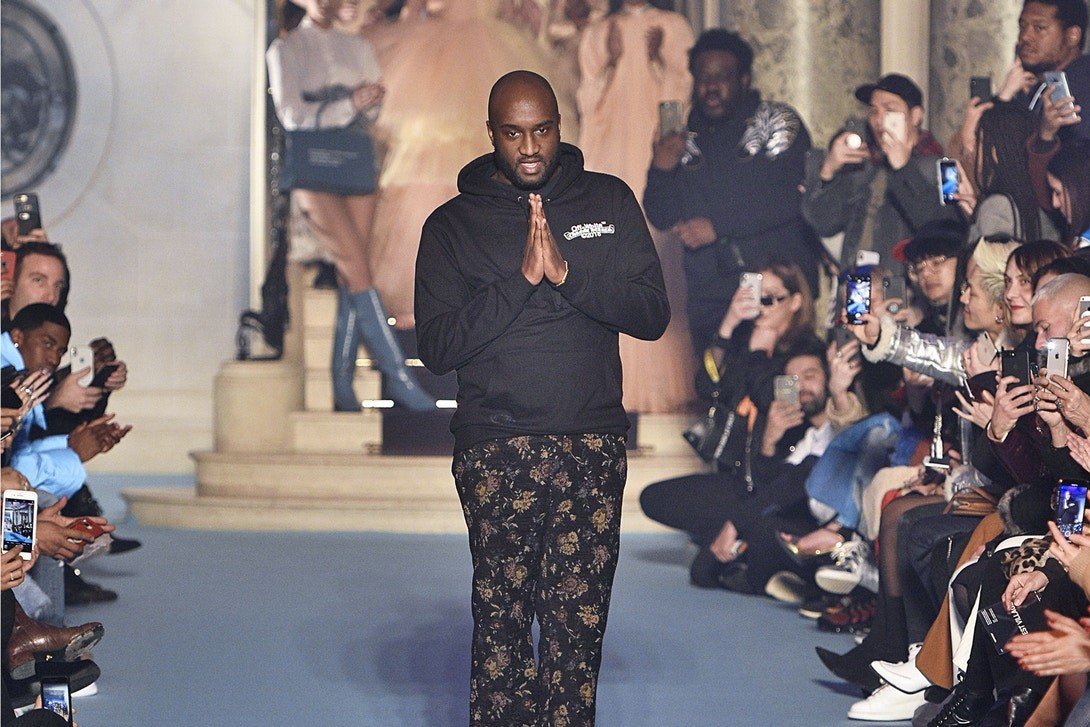
As Virgil Abloh takes his new role as creative director of Louis Vuitton’s menswear line, the world celebrates the landmark achievement. This is the first time a designer of color is taking the helm at the prestigious fashion house, LVMH Moët Hennessy Louis Vuitton, the biggest label owned by the world’s largest luxury holdings group. It’s also only the third time a black designer will have creative control over a French luxury brand after Olivier Rousteing at Balmain and Ozwald Boateng, former designer of Givenchy menswear from 2003 to 2007.
Since its inception, fashion has been dominated by white men. From the golden age of Haute Couture in the 1950’s, the excess and logomania of the 1980’s and 90’s, down to the emergence of urban streetwear in the early 2000’s, white men have been the staple tastemakers of fashion. Abloh’s success in gaining the creative directorship at Louis Vuitton signals a cultural shift in the industry.
Previously, the issue of racial inequality was pigeonholed in the modeling side of fashion, questioning why black models were not as demanded as white models. But while black models weren’t getting the runway attention they deserved, black designers, fashion writers, and fashion businessmen were barely noticed by the biggest players in the industry. From the 90’s to early 2000’s, the only fashion personality black people can look up to was Andre Leon Talley, former editor-at-large of Vogue magazine and right-hand man of Anna Wintour, the “most powerful woman in fashion.” He was the only visible person of color in a powerful position in a predominantly white industry.
It was only in 2016, 18 years since Talley started in Vogue and three years since he left it, that another black editor rose to prominence: Edward Enninful. Enninful succeeded Alexandra Shulman as British Vogue’s new editor-in-chief, bringing along a more diverse editorial staff and contributors. Similarly to Abloh’s appointment in Louis Vuitton, Enninful’s was also an important moment for a sector in the industry where it seemed impossible that a black person could rise up in the ranks. For now, against a sea of white editors, journalists, and writers, both Talley and Enninful stand out as the only black editors sitting front row at all the major fashion shows.
Through the years, fashion has become an emblem of new ideas and self-expression, both of which people of color have massive amounts of. For black people, there’s the Jazz age of the 1920’s, the “afro-tastic” Disco age of the 1970’s, and the urban streetwear from the early 2000’s to today. A lot of what has influenced fashion through the years were thought up by black people, and those are just from the United States. In Africa, a treasure trove of ethnic cultures and traditions have inspired some of the most influential designers through the years.
But what can’t be denied is that those same people, whose cultures have inspired some of the most beautiful fashions the whole world has ever seen, are completely under-appreciated. They’re often used for their talents, but seldom acclaimed for it. They’re often included as a touch of exoticism, but never on the forefront. With Abloh’s latest hiring, things may soon be changing.
Abloh himself, prior to gaining the Louis Vuitton spot, has become famous in his own right. His label, Off-White, has become one of the most prominent streetwear brands in recent years, amassing 3.2 million followers on Instagram. It has gained loyalty from a number of prominent personalities, including legendary supermodel Naomi Campbell, rapper Drake, even football star Cristiano Ronaldo. His already established name puts to light that it may be possible for a colored designer to achieve that much success.
Incidentally, Virgil Abloh’s appointment as Louis Vuitton’s new creative director for menswear garnered many questions. Is it simply a marketing tactic? Some have said yes, due to his social media presence and celebrity collections. While others have disagreed, citing his success with his own brand as proof that he’s ready to take on the retail juggernaut.
It’s no question Abloh has talent. He wouldn’t be given such an important position if he didn’t. But there’s also no question that his connections and influence is “money-in-the-bank” for the brand, especially since it’s one that also relies partially on hype for success. Although Abloh and Louis Vuitton are both more than hype, the idea that hype is the reason both came together in the first place is inescapable. Upon the hiring of Abloh, Louis Vuitton is also getting a bigger fanbase, more than what previous creative directors have amassed. Through his relationships with rappers Kanye West and Jay-Z, Abloh is well-known among the hip-hop music industry and the streetwear aficionados. He also has had collaborations with the likes of Nike and Ikea, which may make him even more famous. Such popularity is what a brand like Louis Vuitton strives for, and they may be getting just that by hiring Abloh.
This particular hiring has certainly sparked numerous conversations, some uncomfortable but completely necessary. The weight has been put on Abloh’s shoulders, and the industry certainly can’t wait what his first move will be.